
Mouse Guards and Entrance Reducers: Small Fixes That Save Winter Colonies
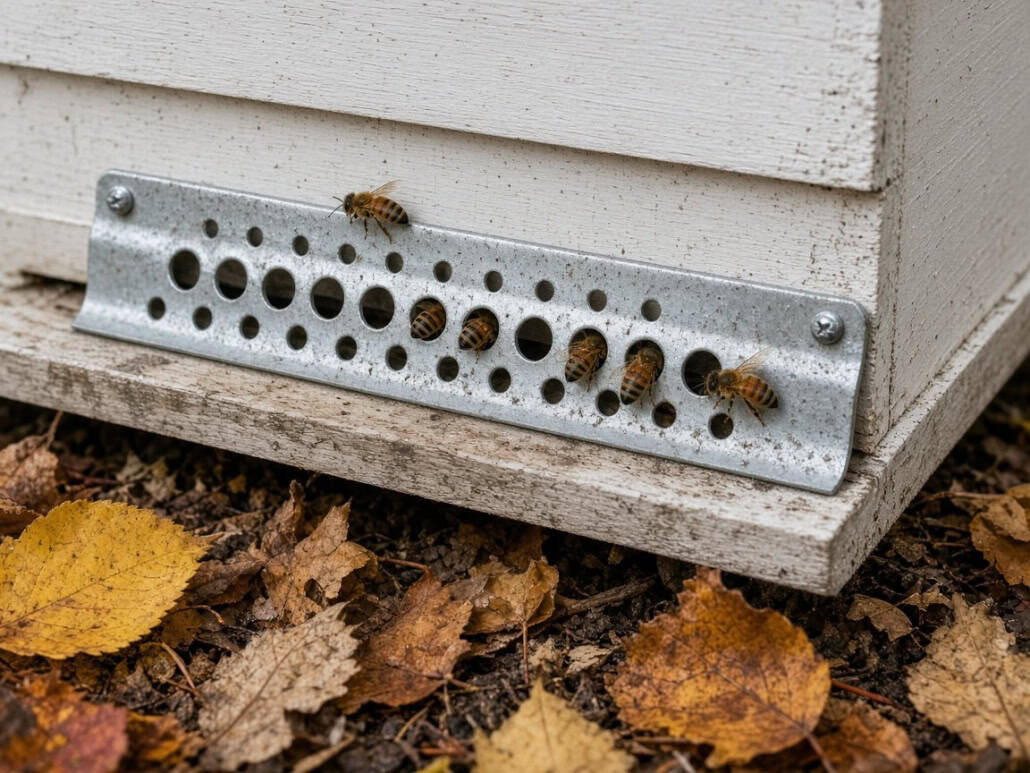
When the first cold nights arrive in October, field mice start looking for somewhere warm to spend the winter. A beehive is about as good as it gets: warm air, soft comb to nest in and food stores. A mouse guard on the beehive entrance is one of the cheapest pieces of equipment you will buy, and it saves a lot of winter colonies.
What Mice Do Inside a Hive
A mouse usually slips in while the bees are clustered and too cold to defend the bottom of the hive. It chews out a nest in the comb, often in a corner of the lower box, and fills it with grass and leaves. The University of Nebraska-Lincoln Extension describes mice chewing comb and wood, soiling equipment and disturbing the cluster (UNL Extension G2361). By spring, you find ruined frames, a smell and sometimes a dead colony that was stressed all winter.

Entrance Reducer vs. Mouse Guard
- Entrance reducer: a wooden strip that narrows the entrance. It helps a colony defend against robbing bees and wasps and keeps out some wind. A determined mouse can still squeeze through or chew the wood.
- Mouse guard: a metal strip with small holes, about 3/8 inch, that bees can walk through but mice cannot. Metal does not chew.
Many beekeepers use a reducer in late summer for robbing and switch to a metal guard for winter. Several extension and beekeeping sources recommend not stacking a guard over a wooden reducer, since the combination can clog with dead bees and block airflow.
When to Put It On
Install the guard before nights get cold enough for the bees to cluster, which in Northwest Ohio usually means early to mid-October. Check first that no mouse is already inside. If you find one during your fall hive inspection, remove the nest before closing up, or you will be locking the mouse in with the bees.
Winter Checks
- After cold snaps, clear dead bees from behind the guard with a stick or wire so the entrance does not plug.
- After snow, make sure the entrance is not buried.
- Look at what is on the ground in front of the hive. Chewed wax bits and droppings are a sign of a visitor.
Other Uninvited Guests
Mice are not the only pest that exploits a weak or cold colony. Small hive beetles and wax moths also move in when bees cannot patrol the whole hive. Read our post on the small hive beetle, and our guide to winterizing beehives for the rest of the winter prep.
Questions?
Call or text 419-614-6445. If you have honeybees in a wall or building rather than a hive, in-wall honeybee removals are being scheduled for Spring 2027. Our sister company covers that on its honeybee removal and relocation page.


