
• Link to Facebook
  • Link to Youtube
  • Link to Dribbble
TMB Honey Price 2025

Sustainability From Rescue to Harvest | 419-614-6445

  • Shopping Cart Shopping Cart
    0Shopping Cart
The Mindful Beekeeper
  • Home
  • Wasp & Bee Removal
    • Yellowjacket Nest Extraction
    • Northwest Ohio
    • Defiance, Ohio
    • Findlay, Ohio
    • Fostoria, Ohio
    • Fremont, Ohio
    • Marion, Ohio
    • Mansfield, Ohio
    • Napoleon, Ohio
    • Oregon, Ohio
    • Tiffin, Ohio
    • Toledo, Ohio
    • Port Clinton, Ohio
  • Wall & Ceiling Cuts
    • Honeybee Wall Cuts (Schedule For 2027)
  • Services
    • Honeybee Swarm Rescue
      • Fulton County, OH
      • Lucas County, OH
      • Hancock County, OH
      • Henry County, OH
      • Ottawa County, OH
      • Sandusky County, OH
      • Seneca County, OH
      • Wood County, OH
      • Wyandot County, OH
    • Specialty Services
      • Bees in Wall Removal
      • Bees in Chimney Removal
      • Thermal Camera Scans
      • Swarm Removal
  • About
    • Apiary #2 – Van Buren, OH Local Honey
    • Beehive Sponsorship Program
    • Beekeeper Blog
      • More on the Honeybee Vaccine From Dalan Animal Health
      • The Year the Hives Went Silent: Inside 2025’s Massive Honey Bee Die‑Off
      • When a Beekeeper Gifts You a Jar of Honey
    • Projects
      • 2025 Honeybee Rescues
      • 2026 Honeybee Rescues
    • Gallery
      • Farm Flowers
      • Video Library
    • 2026 Beehive Sponsors
      • 2026 Beehive Sponsor: Fort Findlay Coffee & Doughnut Shoppe
      • 2026 Beehive Sponsor: Sisters in Shelter
  • Shop
    • Raw Local Honey (Seneca County, OH)
    • TOLENTO™ Coffee Infused Honey
    • TOLENTO™ Coffee Roasters
    • Raw Local Bee Pollen
    • Fast Growing Trees & Shrubs
  • Contact
  • Menu Menu
Beekeeping, Winter Beekeeping

The Last Hive Check of Fall: What I Look for Before Closing Up for Winter
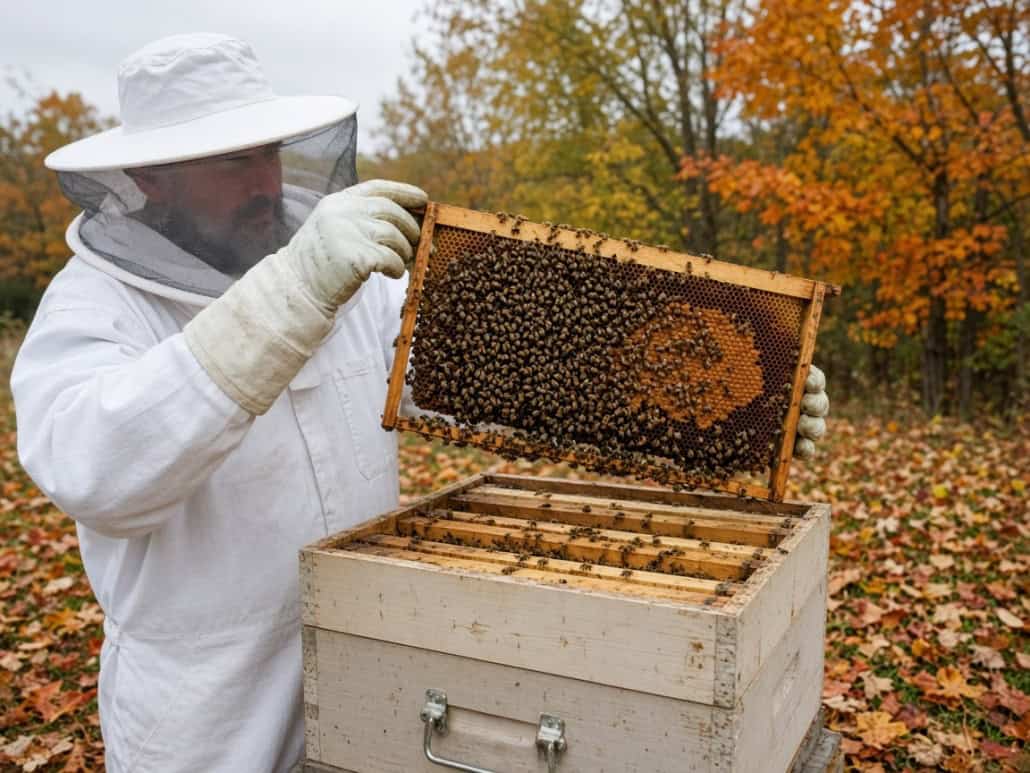
A beekeeper in a veil lifts a frame of capped honey from a hive surrounded by autumn leaves

Every fall there is one last day when I open each hive, pull a few frames and make my final calls for the year. After that, the lids stay on until spring. A good fall hive inspection is short, but it decides a lot about which colonies make it to April in Northwest Ohio. Here is what I check, in the order I check it.

Pick the Right Day

The last inspection should happen on a calm, sunny afternoon while it is still mild enough for bees to fly. Once the cluster forms for the season, pulling frames breaks it apart and lets heat out. Cornell’s pollinator program notes that colonies need to be fully prepared for winter in fall, because there is little a beekeeper can fix once cold weather sets in (Cornell CALS, Overwintering). I work quickly, keep the smoker light and close each hive within a few minutes.

1. Queen Status

I am not always looking for the queen herself. I am looking for evidence that she is there and laying. In late fall the brood nest shrinks a lot, so a small patch of capped brood or a few eggs is enough. A colony with no brood at all and no queen this late will not raise a new one in time, and it usually goes into winter as a slowly shrinking group of old bees. Spotty brood this late is normal; no brood plus agitated, roaring bees is the warning sign.

2. Honey Stores

Starvation ends more colonies than cold does. I look for capped honey arched over and beside the cluster and I heft the back of the hive to judge weight. Cornell recommends that a full-size colony in the Northeast go into winter with roughly 90 to 100 pounds of honey. Our post on how much honey bees need for winter goes deeper on hefting and counting frames.

This is also why our rule at the apiary is simple: our honeybees take priority over selling honey, and we only take honey from strong hives that have more than they need for winter.

Blue-gloved hand holding a mason jar with a mesh lid full of sugar-dusted honeybees over a white tray beside a hive
A sugar roll gives a quick mite count before the colony goes into winter.

3. A Last Mite Count

Varroa mites are the biggest single threat to a colony’s winter survival. A sugar roll or alcohol wash on about half a cup of bees from the brood area gives a quick count. If the count is high, the window for treatment is still open, and late fall into early winter is when many colonies in our area are nearly broodless, which is when oxalic acid works best. We cover timing and methods in oxalic acid treatments for varroa mites. Always follow the product label.

4. Cluster Size and Position

A strong colony going into winter covers several frames, and I like to see the bees sitting in the lower box with honey above them. Bees move up through their stores during winter, so honey above the cluster matters more than honey off to the side.

5. Entrance and Equipment

  • Entrance: reduced or guarded before mice move in. See our guide to mouse guards and entrance reducers.
  • Boxes and lids: no cracks, gaps or warped covers that let rain and wind in.
  • Tilt: a slight forward tilt so condensation and rain drain out the front.
  • Wind: a wind break on the north and west sides helps a lot on open farmland.

Wrapping and insulation come after this inspection, not during it. Our guide to winterizing beehives covers that step.

What I Do With the Results

Every colony gets one of three labels in my notes: ready, needs help (feed, treat or combine), or not going to make it. Weak colonies with a good queen can sometimes be combined with a stronger one over newspaper so the bees are not lost. Being honest about a weak hive in October is better than finding a dead one in March.

Watch the Inspection

We filmed one of these pre-winter checks in Ohio. You can watch it here: Beehive inspection complete prior to winter in Ohio, and find more on our YouTube channel.

Honeybees in a Wall or Building?

Fall is when a lot of homeowners notice a colony that has been living in a wall all summer. Honeybee colonies do not die off in winter the way wasp nests do. In-wall honeybee removals are being scheduled for Spring 2027. Call or text 419-614-6445, or see our sister company’s humane honeybee removal and relocation page.

Sources

  • Cornell University CALS Pollinator Network: Overwintering
  • University of Florida IFAS: Overwintering Honey Bee Colonies in Northern Climates
October 27, 2026/by The Mindful Beekeeper
Share this entry
  • Share on Facebook
  • Share on X
  • Share on Pinterest
  • Share on LinkedIn
  • Share on Tumblr
  • Share on Vk
  • Share on Reddit
  • Share by Mail
https://themindfulbeekeeper.com/wp-content/uploads/2026/10/beekeeper-fall-hive-inspection-frame.jpg 864 1152 The Mindful Beekeeper https://themindfulbeekeeper.com/wp-content/uploads/2026/08/Screenshot-2026-08-28-at-1.27.08-AM.png The Mindful Beekeeper2026-10-27 13:00:002026-10-27 13:00:00The Last Hive Check of Fall: What I Look for Before Closing Up for Winter

[instagram-feed feed=1]

Quick Connect

Blank Form (#5)

Call or Text Instead
419-614-6445

Office Location/Apiary #1

12860 W TR 114,
Loudon Township,
Seneca County, OH 44830

Farm/Apiary Hours:

By Appointment Only

Archives

  • November 2026
  • October 2026
  • September 2026
  • August 2026
  • April 2026
  • February 2026
  • January 2026
  • December 2025
  • November 2025
  • October 2025
  • August 2025
  • July 2025
  • May 2025

Categories

  • 2026 Beehive Sponsor
  • 2026 Honeybee Rescues
  • Alchemy Bee
  • Bee Pollen
  • Bee Removal
  • Beehive Sponsors
  • Beehives
  • Beekeeping
  • Beekeeping With Fibromyalgia
  • Defiance
  • Fostoria
  • Honey Benefits
  • Honey Infusions
  • Honeybee Removal & Relocation
  • Honeybee Rescue
  • Infused Honey
  • Knowledge Base
  • Maple Syrup
  • Mindful Beekeeping
  • Mindfulness
  • Northwest Ohio
  • Northwest Ohio Bee Removal
  • Ohio
  • Opossums
  • Pesticide Free Pest Control
  • Seneca County Ohio Bee Removal
  • Tolento™ Coffee Infused Honey
  • Uncategorized
  • Van Buren
  • Wasp Control
  • Wildlife
  • Winter Beekeeping
  • Yellow Jacket Control
  • YouTube Channel

Scheduling Availability

Monday: 12PM – 7PM
Tuesday: 12PM – 7PM
Wednesday: 12PM – 7PM
Thursday: 12PM – 7PM
Friday: 12PM – 7PM
Saturday: 12PM – 7PM
Sunday: 12PM – 7PM


Got Honeybees? Get on the list early and schedule a removal today. 

Tags

#WaspRemoval #WaspSeason #WaspControl #WaspHiveRemoval #BeeKeeping #BeeKeeper #HoneyBeeRescue #HoneyBeeRemoval

© Copyright - The Mindful BeeKeeper LLC. Website Designed by Tolento Media Group
  • Link to Facebook
  • Link to Youtube
  • Link to Dribbble
Link to: Calm Bees Are Happy Bees — This Colony in NW Ohio is Loaded & Ready to be Moved Link to: Calm Bees Are Happy Bees — This Colony in NW Ohio is Loaded & Ready to be Moved Calm Bees Are Happy Bees — This Colony in NW Ohio is Loaded & Ready to... Link to: Goldenrod and Aster Honey: Why Fall Honey Smells and Tastes Different Link to: Goldenrod and Aster Honey: Why Fall Honey Smells and Tastes Different A honeybee gathering nectar on bright yellow goldenrod flowers in a late-summer fieldGoldenrod and Aster Honey: Why Fall Honey Smells and Tastes Different
Scroll to top Scroll to top Scroll to top