
• Link to Facebook
  • Link to Youtube
  • Link to Dribbble
TMB Honey Price 2025

Sustainability From Rescue to Harvest | 419-614-6445

  • Shopping Cart Shopping Cart
    0Shopping Cart
The Mindful Beekeeper
  • Home
  • Wasp & Bee Removal
    • Yellowjacket Nest Extraction
    • Northwest Ohio
    • Defiance, Ohio
    • Findlay, Ohio
    • Fostoria, Ohio
    • Fremont, Ohio
    • Marion, Ohio
    • Mansfield, Ohio
    • Napoleon, Ohio
    • Oregon, Ohio
    • Tiffin, Ohio
    • Toledo, Ohio
    • Port Clinton, Ohio
  • Wall & Ceiling Cuts
    • Honeybee Wall Cuts (Schedule For 2027)
  • Services
    • Honeybee Swarm Rescue
      • Fulton County, OH
      • Lucas County, OH
      • Hancock County, OH
      • Henry County, OH
      • Ottawa County, OH
      • Sandusky County, OH
      • Seneca County, OH
      • Wood County, OH
      • Wyandot County, OH
    • Specialty Services
      • Bees in Wall Removal
      • Bees in Chimney Removal
      • Thermal Camera Scans
      • Swarm Removal
  • About
    • Apiary #2 – Van Buren, OH Local Honey
    • Beehive Sponsorship Program
    • Beekeeper Blog
      • More on the Honeybee Vaccine From Dalan Animal Health
      • The Year the Hives Went Silent: Inside 2025’s Massive Honey Bee Die‑Off
      • When a Beekeeper Gifts You a Jar of Honey
    • Projects
      • 2025 Honeybee Rescues
      • 2026 Honeybee Rescues
    • Gallery
      • Farm Flowers
      • Video Library
    • 2026 Beehive Sponsors
      • 2026 Beehive Sponsor: Fort Findlay Coffee & Doughnut Shoppe
      • 2026 Beehive Sponsor: Sisters in Shelter
  • Shop
    • Raw Local Honey (Seneca County, OH)
    • TOLENTO™ Coffee Infused Honey
    • TOLENTO™ Coffee Roasters
    • Raw Local Bee Pollen
    • Fast Growing Trees & Shrubs
  • Contact
  • Menu Menu
Beekeeping, Winter Beekeeping

How Much Honey Does a Colony Need to Get Through an Ohio Winter?
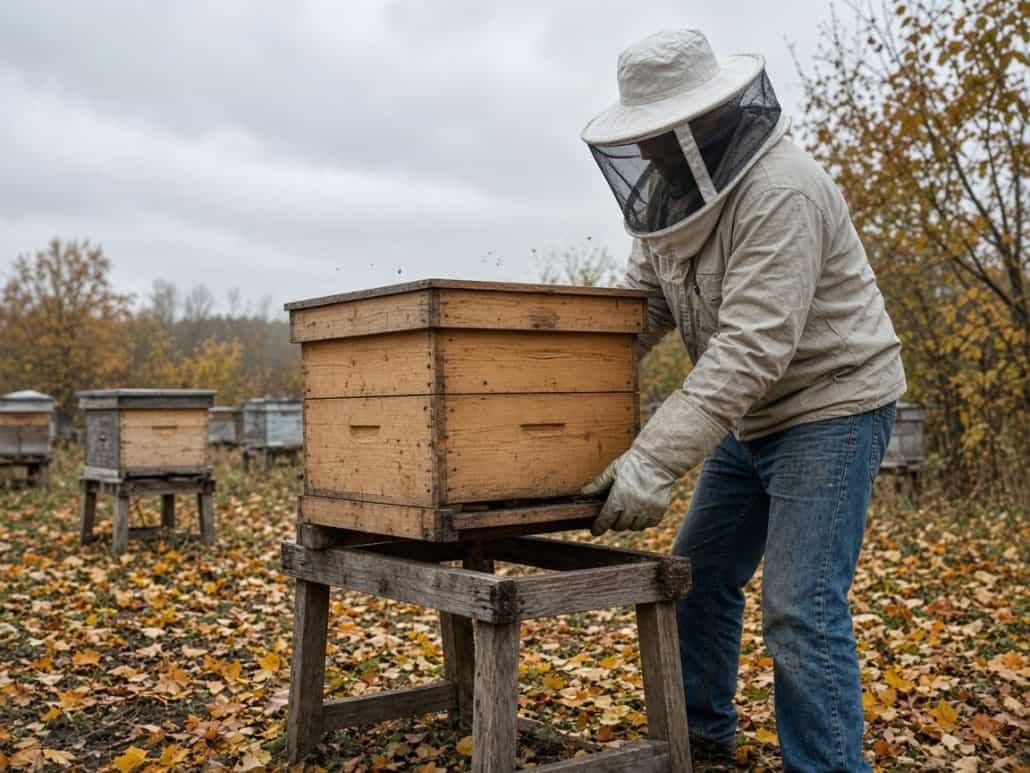
A beekeeper in a veil and gloves grips the bottom of a two-box wooden beehive on a stand to judge its weight in an autumn apiary

People are often surprised to learn that cold is not what kills most honeybee colonies in an Ohio winter. A healthy cluster can handle subzero nights. What it cannot handle is running out of food. So the question every beekeeper asks in October is the same: how much honey do bees need for winter, and does this hive have it?

The Short Answer

For a full-size colony in a northern climate, Cornell’s pollinator program recommends going into winter with roughly 90 to 100 pounds of honey, about the weight of one full deep box of honey (Cornell CALS). The University of Florida’s guide to overwintering in northern climates gives similar advice and stresses that colonies should be heavy before cold weather sets in (UF/IFAS). Smaller colonies use less, but they also have less margin for a long, cold spring.

Winter in Northwest Ohio does not really end in March. Colonies start raising brood again in late winter, which burns through stores fast, and a cold, wet April can starve a colony that looked fine in February.

How I Check: Hefting

The quickest check is to lift the back of the hive an inch or two off its stand. With practice, you learn what a heavy hive feels like. The University of Minnesota Bee Lab describes the same test: if the hive is hard to tip back, stores are likely adequate; if it lifts easily, the colony needs help (UMN Bee Lab). I heft every hive in October and again on mild days through winter, without opening it.

A deep wooden frame almost completely covered in white wax-capped honey
A full deep frame of capped honey. Several of these surrounding the cluster is what I like to see in fall.

How I Check: Counting Frames

During the last open inspection, I count frames of capped honey. A full deep frame of honey weighs several pounds, so a box packed edge to edge is a good sign. What matters just as much is where the honey sits. The cluster moves upward through the winter. Honey above the bees is easy to reach; honey off to the far side may be out of reach on a cold week. Our fall hive inspection checklist covers what else I look at that day.

Why We Only Take From Strong Hives

Our rule at the apiary is written on our home page for a reason: our honeybees take priority over selling honey, and we only take from strong beehives with more than they need for winter. A jar of honey is not worth a dead colony. In practice, a lot of hives give us no honey at all in a given year, and that is fine.

What If a Hive Is Light?

  • Early fall: feed thick sugar syrup while the bees can still process and store it. See our guide to fall feeding.
  • Once it is cold: switch to dry sugar, fondant or sugar bricks placed right above the cluster. The UMN Bee Lab has a good overview of winter sugar feeding.
  • Move honey: a frame of capped honey from a heavy hive can go into a light one, if both colonies are healthy.

More on Winter Bees

What the bees do with those stores is a story of its own. Read what honeybees do during an Ohio winter and our guide to winterizing beehives.

Honeybees Living in Your Walls?

A feral colony in a wall has the same need for stores and will stay put all winter. In-wall honeybee removals are being scheduled for Spring 2027. Call or text 419-614-6445, or visit our sister company’s honeybee removal and relocation page.

Sources

  • Cornell University CALS Pollinator Network: Overwintering
  • University of Florida IFAS: Overwintering Honey Bee Colonies in Northern Climates
  • University of Minnesota Bee Lab: Feeding Bees Sugar in Winter
November 3, 2026/by The Mindful Beekeeper
Share this entry
  • Share on Facebook
  • Share on X
  • Share on Pinterest
  • Share on LinkedIn
  • Share on Tumblr
  • Share on Vk
  • Share on Reddit
  • Share by Mail
https://themindfulbeekeeper.com/wp-content/uploads/2026/10/beekeeper-hefting-hive-in-autumn.jpg 864 1152 The Mindful Beekeeper https://themindfulbeekeeper.com/wp-content/uploads/2026/08/Screenshot-2026-08-28-at-1.27.08-AM.png The Mindful Beekeeper2026-11-03 14:00:002026-11-03 14:00:00How Much Honey Does a Colony Need to Get Through an Ohio Winter?

[instagram-feed feed=1]

Quick Connect

Blank Form (#5)

Call or Text Instead
419-614-6445

Office Location/Apiary #1

12860 W TR 114,
Loudon Township,
Seneca County, OH 44830

Farm/Apiary Hours:

By Appointment Only

Archives

  • November 2026
  • October 2026
  • September 2026
  • August 2026
  • April 2026
  • February 2026
  • January 2026
  • December 2025
  • November 2025
  • October 2025
  • August 2025
  • July 2025
  • May 2025

Categories

  • 2026 Beehive Sponsor
  • 2026 Honeybee Rescues
  • Alchemy Bee
  • Bee Pollen
  • Bee Removal
  • Beehive Sponsors
  • Beehives
  • Beekeeping
  • Beekeeping With Fibromyalgia
  • Defiance
  • Fostoria
  • Honey Benefits
  • Honey Infusions
  • Honeybee Removal & Relocation
  • Honeybee Rescue
  • Infused Honey
  • Knowledge Base
  • Maple Syrup
  • Mindful Beekeeping
  • Mindfulness
  • Northwest Ohio
  • Northwest Ohio Bee Removal
  • Ohio
  • Opossums
  • Pesticide Free Pest Control
  • Seneca County Ohio Bee Removal
  • Tolento™ Coffee Infused Honey
  • Uncategorized
  • Van Buren
  • Wasp Control
  • Wildlife
  • Winter Beekeeping
  • Yellow Jacket Control
  • YouTube Channel

Scheduling Availability

Monday: 12PM – 7PM
Tuesday: 12PM – 7PM
Wednesday: 12PM – 7PM
Thursday: 12PM – 7PM
Friday: 12PM – 7PM
Saturday: 12PM – 7PM
Sunday: 12PM – 7PM


Got Honeybees? Get on the list early and schedule a removal today. 

Tags

#WaspRemoval #WaspSeason #WaspControl #WaspHiveRemoval #BeeKeeping #BeeKeeper #HoneyBeeRescue #HoneyBeeRemoval

© Copyright - The Mindful BeeKeeper LLC. Website Designed by Tolento Media Group
  • Link to Facebook
  • Link to Youtube
  • Link to Dribbble
Link to: Goldenrod and Aster Honey: Why Fall Honey Smells and Tastes Different Link to: Goldenrod and Aster Honey: Why Fall Honey Smells and Tastes Different Goldenrod and Aster Honey: Why Fall Honey Smells and Tastes DifferentA honeybee gathering nectar on bright yellow goldenrod flowers in a late-summer field
Scroll to top Scroll to top Scroll to top