
• Link to Facebook
  • Link to Youtube
  • Link to Dribbble
TMB Honey Price 2025

Sustainability From Rescue to Harvest | 419-614-6445

  • Shopping Cart Shopping Cart
    0Shopping Cart
The Mindful Beekeeper
  • Home
  • Wasp & Bee Removal
    • Yellowjacket Nest Extraction
    • Northwest Ohio
    • Defiance, Ohio
    • Findlay, Ohio
    • Fostoria, Ohio
    • Fremont, Ohio
    • Marion, Ohio
    • Mansfield, Ohio
    • Napoleon, Ohio
    • Oregon, Ohio
    • Tiffin, Ohio
    • Toledo, Ohio
    • Port Clinton, Ohio
  • Wall & Ceiling Cuts
    • Honeybee Wall Cuts (Schedule For 2027)
  • Services
    • Honeybee Swarm Rescue
      • Fulton County, OH
      • Lucas County, OH
      • Hancock County, OH
      • Henry County, OH
      • Ottawa County, OH
      • Sandusky County, OH
      • Seneca County, OH
      • Wood County, OH
      • Wyandot County, OH
    • Specialty Services
      • Bees in Wall Removal
      • Bees in Chimney Removal
      • Thermal Camera Scans
      • Swarm Removal
  • About
    • Apiary #2 – Van Buren, OH Local Honey
    • Beehive Sponsorship Program
    • Beekeeper Blog
      • More on the Honeybee Vaccine From Dalan Animal Health
      • The Year the Hives Went Silent: Inside 2025’s Massive Honey Bee Die‑Off
      • When a Beekeeper Gifts You a Jar of Honey
    • Projects
      • 2025 Honeybee Rescues
      • 2026 Honeybee Rescues
    • Gallery
      • Farm Flowers
      • Video Library
    • 2026 Beehive Sponsors
      • 2026 Beehive Sponsor: Fort Findlay Coffee & Doughnut Shoppe
      • 2026 Beehive Sponsor: Sisters in Shelter
  • Shop
    • Raw Local Honey (Seneca County, OH)
    • TOLENTO™ Coffee Infused Honey
    • TOLENTO™ Coffee Roasters
    • Raw Local Bee Pollen
    • Fast Growing Trees & Shrubs
  • Contact
  • Menu Menu
Beekeeping, Winter Beekeeping

Winter Bees vs. Summer Bees: Why Fall-Born Workers Live for Months
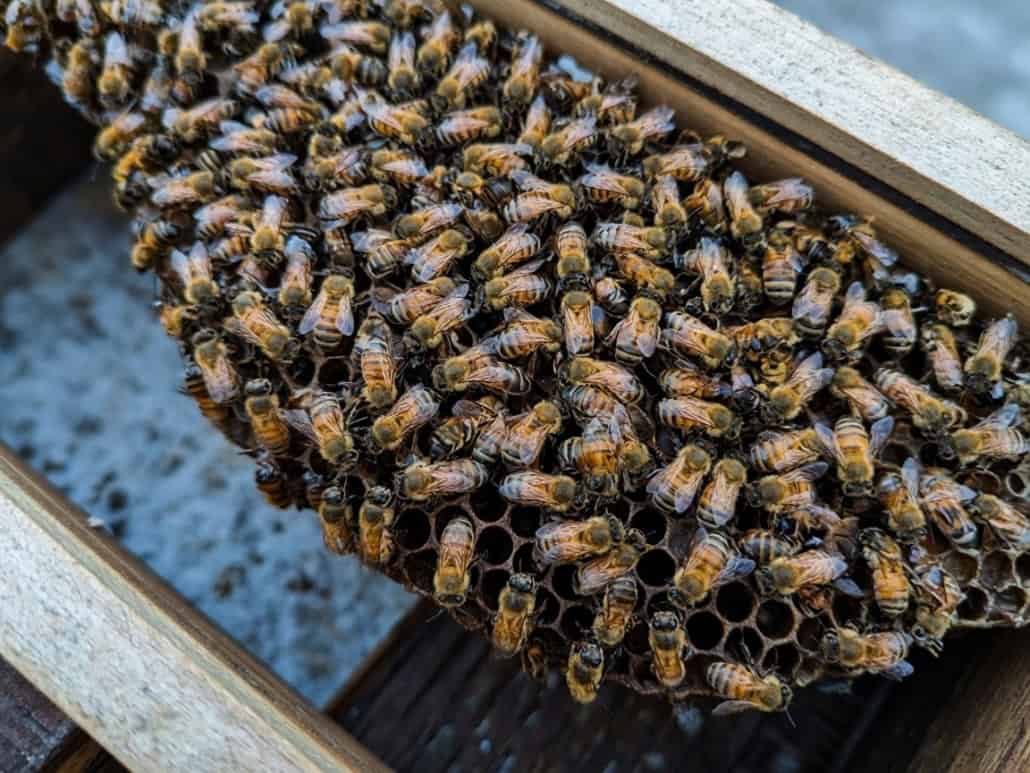
A dense mass of honeybees covering dark comb inside a wooden hive box in cool winter light

A worker honeybee born in June lives about a month. A worker born in October can live until spring. Same colony, same queen, very different bee. These long-lived winter bees are one of the most interesting pieces of honeybee biology, and they explain why late summer matters so much to winter survival.

Two Kinds of Workers

Researchers sometimes call the long-lived fall workers “diutinus” bees, from the Latin for long-lasting. They are not a separate caste. They are ordinary workers that develop differently because of the conditions they are raised in. One research team summarized it this way: when brood rearing is active, workers survive for 3 to 6 weeks; when brood rearing declines, worker lifespan can be 20 weeks or longer (study abstract on PubMed).

What Makes a Winter Bee Different

  • Bigger fat bodies. Winter bees store more fat and protein in their abdomens.
  • More vitellogenin. This storage protein is tied to immunity, nutrition and lifespan. In summer, nurse bees use it up making brood food. When there is little brood to feed, it builds up. A controlled experiment found that reducing brood rearing raised vitellogenin levels and delayed both foraging and death (full study on PMC).
  • Well-developed brood-food glands. Winter bees can raise the first rounds of brood in late winter, before fresh pollen is available.
  • Less flying. Foraging wears bees out. Winter bees mostly stay home.
Gloved hands holding a frame of capped comb with worker bees walking over it in warm late-summer light
Brood capped in late summer and early fall becomes the colony’s winter workforce.

What Triggers the Switch

Dwindling pollen appears to be a major cue. In a study in Ecological Entomology, Mattila and Otis artificially extended or cut short the fall pollen supply. Colonies with more pollen kept raising brood later, but long-lived winter bees did not appear until brood rearing declined (Mattila & Otis, 2007). More recent work suggests that season itself, not only the amount of brood, shapes nurse bee physiology. The full picture is still being studied.

Why August and September Decide Winter

The bees that will carry a colony to spring are raised in late summer and early fall. If those bees develop while the colony has a heavy varroa load, or while forage is poor, the winter population starts out weak. That is why many beekeepers treat for mites in late summer rather than waiting for a low count in November. By then, the winter bees have already been raised. Our post on oxalic acid treatments covers winter timing.

What Winter Bees Do All Winter

They form the cluster, shiver their flight muscles to make heat, rotate between the warm core and the cooler outer shell and slowly eat their way through stored honey. Read more in The Winter Cluster: How Honeybees Defy Physics and what honeybees do during an Ohio winter. For stores, see how much honey bees need for winter.

Questions about your bees? Call or text 419-614-6445.

Sources

  • Brood pheromone suppresses physiology of extreme longevity in honeybees (PubMed)
  • The nurse’s load: early-life exposure to brood-rearing affects behavior and lifespan in honey bees (PMC)
  • Mattila & Otis: Dwindling pollen resources trigger the transition to broodless populations of long-lived honeybees each autumn
November 17, 2026/by The Mindful Beekeeper
Share this entry
  • Share on Facebook
  • Share on X
  • Share on Pinterest
  • Share on LinkedIn
  • Share on Tumblr
  • Share on Vk
  • Share on Reddit
  • Share by Mail
https://themindfulbeekeeper.com/wp-content/uploads/2026/10/honeybee-cluster-on-comb-cool-light.jpg 864 1152 The Mindful Beekeeper https://themindfulbeekeeper.com/wp-content/uploads/2026/08/Screenshot-2026-08-28-at-1.27.08-AM.png The Mindful Beekeeper2026-11-17 14:00:002026-11-17 14:00:00Winter Bees vs. Summer Bees: Why Fall-Born Workers Live for Months

[instagram-feed feed=1]

Quick Connect

Blank Form (#5)

Call or Text Instead
419-614-6445

Office Location/Apiary #1

12860 W TR 114,
Loudon Township,
Seneca County, OH 44830

Farm/Apiary Hours:

By Appointment Only

Archives

  • November 2026
  • October 2026
  • September 2026
  • August 2026
  • April 2026
  • February 2026
  • January 2026
  • December 2025
  • November 2025
  • October 2025
  • August 2025
  • July 2025
  • May 2025

Categories

  • 2026 Beehive Sponsor
  • 2026 Honeybee Rescues
  • Alchemy Bee
  • Bee Pollen
  • Bee Removal
  • Beehive Sponsors
  • Beehives
  • Beekeeping
  • Beekeeping With Fibromyalgia
  • Defiance
  • Fostoria
  • Honey Benefits
  • Honey Infusions
  • Honeybee Removal & Relocation
  • Honeybee Rescue
  • Infused Honey
  • Knowledge Base
  • Maple Syrup
  • Mindful Beekeeping
  • Mindfulness
  • Northwest Ohio
  • Northwest Ohio Bee Removal
  • Ohio
  • Opossums
  • Pesticide Free Pest Control
  • Seneca County Ohio Bee Removal
  • Tolento™ Coffee Infused Honey
  • Uncategorized
  • Van Buren
  • Wasp Control
  • Wildlife
  • Winter Beekeeping
  • Yellow Jacket Control
  • YouTube Channel

Scheduling Availability

Monday: 12PM – 7PM
Tuesday: 12PM – 7PM
Wednesday: 12PM – 7PM
Thursday: 12PM – 7PM
Friday: 12PM – 7PM
Saturday: 12PM – 7PM
Sunday: 12PM – 7PM


Got Honeybees? Get on the list early and schedule a removal today. 

Tags

#WaspRemoval #WaspSeason #WaspControl #WaspHiveRemoval #BeeKeeping #BeeKeeper #HoneyBeeRescue #HoneyBeeRemoval

© Copyright - The Mindful BeeKeeper LLC. Website Designed by Tolento Media Group
  • Link to Facebook
  • Link to Youtube
  • Link to Dribbble
Link to: Can a Late-Season Split Survive a Northwest Ohio Winter? Link to: Can a Late-Season Split Survive a Northwest Ohio Winter? Can a Late-Season Split Survive a Northwest Ohio Winter?A small wooden nuc box on a cinder block with bees at its entrance, with larger hives and yellow autumn trees behind Link to: Honey for the Holidays: Glazes, Brines and Easy Swaps for Thanksgiving Link to: Honey for the Holidays: Glazes, Brines and Easy Swaps for Thanksgiving Roasted carrots with a shiny honey glaze and thyme in a white baking dish beside a jar of honey with a wooden dipperHoney for the Holidays: Glazes, Brines and Easy Swaps for Thanksgiving
Scroll to top Scroll to top Scroll to top